HIS 391 / AS 391: Primary Sources
China in the World
Primary Sources are materials produced during the historical period under examination. These, when contextualized by scholarly secondary sources, provide a means of better understanding the period, people, and topics studied by historians. Primary sources can be any document produced during the period under examination: letters, government documents, art, autobiographies, essays, etc.
Below is a primer on finding Primary Sources for HIS 391 / AS 391. For a more detailed list of resources, see the UB Libraries’ Asian Studies: Primary Sources Guide. In addition to the resources below, remember that you should read the footnotes and bibliographies of the Secondary sources (academic books and articles) to see which primary source other scholars are using.
Below is a primer on finding Primary Sources for HIS 391 / AS 391. For a more detailed list of resources, see the UB Libraries’ Asian Studies: Primary Sources Guide. In addition to the resources below, remember that you should read the footnotes and bibliographies of the Secondary sources (academic books and articles) to see which primary source other scholars are using.
Databases
-
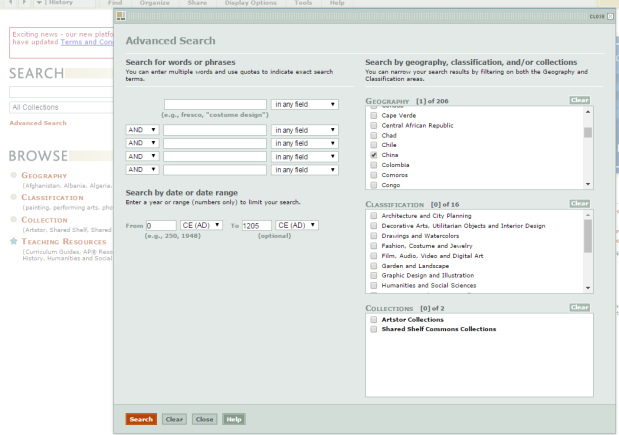
ArtStorA database of images, ArtStor provides high-quality images of documents, art, sculptures, and other objects. Using the “Advanced Search” option on the left, you can limit your search by Geography (ex. “China”) and Date. You can further limit “Classification” to item types, including paintings, manuscripts, and other various object types.
-
Complete Chinese Classics Collection of Ancient ChinaThis database includes over 6,000 documents held by the royal court, containing materials on Chinese literature and culture through the Qing Dynasty. The interface is in Chinese, so English-speakers will need to rely upon the Google Chrome browser’s translation feature.
-
Siku QuanshuA collection from the Qing Dynasty Imperial Library, it contains 800,000 pages from 10,000 silk rolls, covering “5,000 years of Chinese culture.” It requires users to download interface software.
Sourcebooks, Readers, and Other Document Collections in UB Libraries
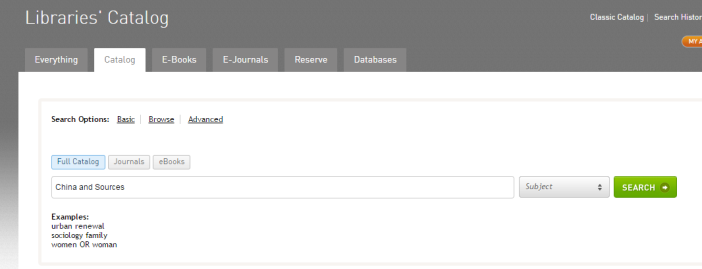
While many individual historical documents have been scanned and placed online, they are often spread across the internet (see “Index” section below for more detail on finding these). To place these materials in a single place, publishers and historians print curated and translated collections of historical documents. These are typically organized into thematic volumes. Called “readers” or “Sourcebooks,” UB owns many of these works. A basic Subject search in the UB Libraries catalog for China and Sources, for example, brings up a number of these useful works:
 Limit the Language to English along the left-hand side of the page.
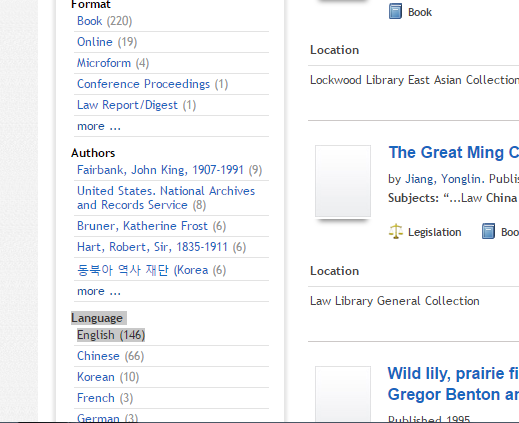 This brings up a number of useful historical document collections (in English), notably:
Autobiographies and Letters
Limit the Language to English along the left-hand side of the page.
This brings up a number of useful historical document collections (in English), notably:
- Urbanization in early and medieval China: gazetteers for the city of Suzhou (Milburn, 2015).
Online - Rewriting early Chinese texts (Shaughnessy, 2006).
Online - Chinese civilization: a sourcebook (Ebrey, 1993).
DS721 .C517 1993 Location: Lockwood Library General Collection - Chinese civilization and society: a sourcebook (Ebrey, 1981).
Lockwood Library General Collection DS721 .C517 - Sources of Chinese tradition (de Bary, Chan, Watson, 1999).
Lockwood Library General Collection DS703 .D4 1999 - Essays on the sources for Chinese history (Leslie, Mackerras, and Gungwu, 1975).
Lockwood Library General Collection DS734.7 .E83 1975 - Records of Han administration (Loewe, 1967).
Lockwood Library General Collection DS748 .L64 - Entombed epigraphy and commemorative culture in early medieval China: a history of early Muzhiming (Davis, 2015).
Lockwood Library General Collection PL2447 .D38 2015 - The destruction of the medieval Chinese aristocracy (Tackett, 2014).
DS749.35 .T33 2014 Location: Lockwood Library General Collection - A source book in Chinese philosophy (Chan, 1962).
Lockwood Library General Collection B125 .C45 - Diary; the record of a pilgrimage to China in search of the law; translated from the Chinese by Edwin O. Reischauer (1955).
Lockwood Library General Collection DS707 .E512
Autobiographies and Letters
Some of the best Primary Sources are letters and autobiographies, which provide a direct voice from the past. These can be found in the catalog by conducting a Subject search for Autobiography. A Subject search for Autobiography and China, for example, brings up the work:
To die and not decay: autobiography and the pursuit of immortality in early China (Wells, 2009)
Lockwood Library General Collection CT34 .C6 W45 2009
To die and not decay: autobiography and the pursuit of immortality in early China (Wells, 2009)
Lockwood Library General Collection CT34 .C6 W45 2009
Narrowing your search for better results
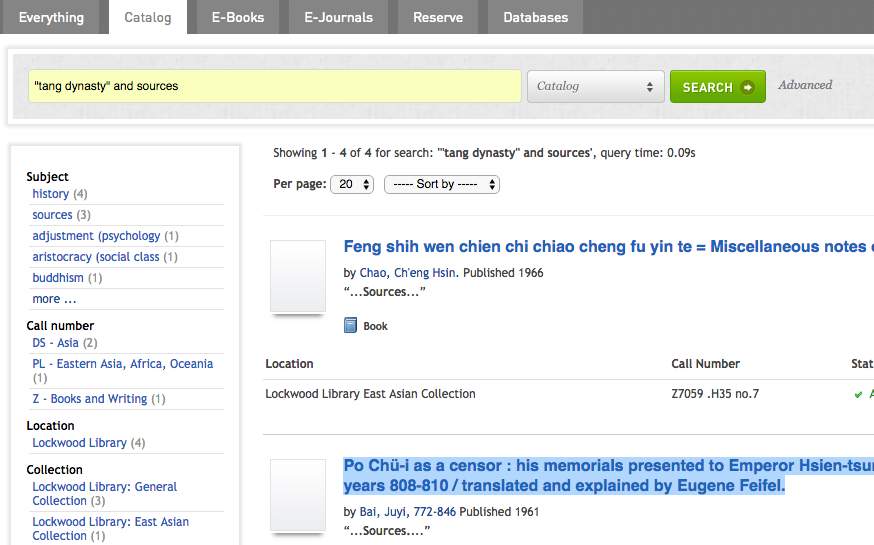
“China” is an extremely broad topic. Try to narrow your search to a specific dynasty, if you can (examples including Tang dynasty, 618-907 or Song dynasty, 960-1279). Substitute “China” with the dynasty of interest, and then try the same searches as above. As an example, a search for “Tang dynasty” and Sources yields interesting results:
 A Subject search for “History” and “Song Dynasty” brings up both Secondary and Primary sources, including an English translation of the Song Dynasty Songshi Salt Monopoly Treatise.
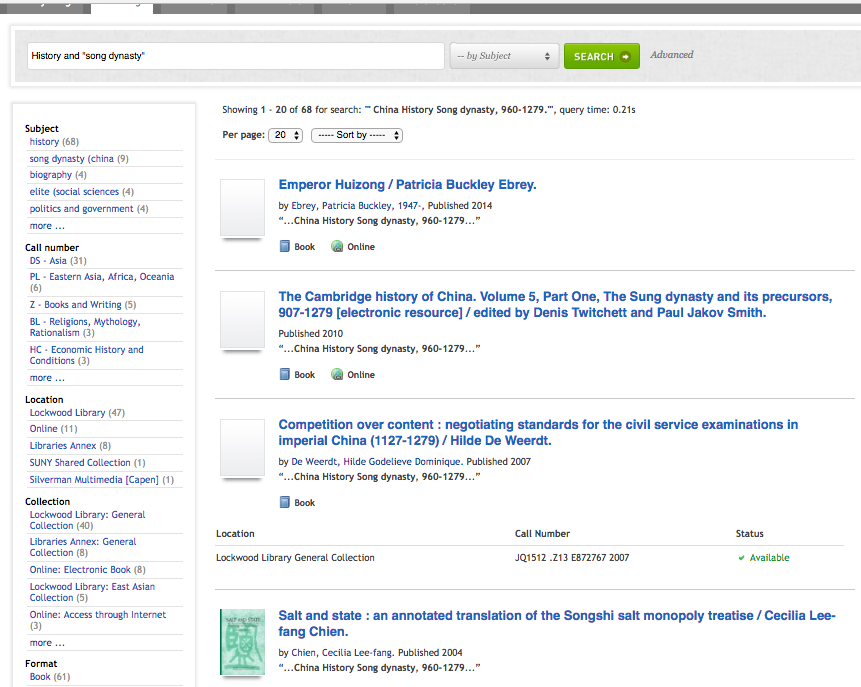
A Subject search for “History” and “Song Dynasty” brings up both Secondary and Primary sources, including an English translation of the Song Dynasty Songshi Salt Monopoly Treatise.
Finding Primary Sources Online
While reading secondary sources (books and academic articles), you will find authors who reference specific historical documents. Often, you can find these either in other published sources, or online. Be sure to read the author’s footnotes and bibliographies!
If you search for documents online, be mindful of the website/source. Does it have a .edu domain? If it is a .org, who is the organization? Is it trustworthy? You may also find primary sources in online collections, or you can use indexes (list of historical documents) to search for specific documents online.
Indexes to Known Historical Documents
Early Medieval Chinese Texts : a bibliographical guide / edited by Cynthia L. Chennault, Keith N. Knapp, Alan J. Berkowitz, Albert E. Dien.
Lockwood Library General Collection PL2284.5 .E27 2014
Catalogue of translations from the Chinese dynastic histories for the period 220-960. Main Author: Frankel, Hans H. (Hans Hermann), 1916-2003.
Lockwood Library General Collection DS741 .C51 no.1
The history of imperial China; a research guide. Main Author: Wilkinson, Endymion Porter. 1973
Lockwood Library General Collection DS734.7 .W5
If you search for documents online, be mindful of the website/source. Does it have a .edu domain? If it is a .org, who is the organization? Is it trustworthy? You may also find primary sources in online collections, or you can use indexes (list of historical documents) to search for specific documents online.
Indexes to Known Historical Documents
Early Medieval Chinese Texts : a bibliographical guide / edited by Cynthia L. Chennault, Keith N. Knapp, Alan J. Berkowitz, Albert E. Dien.
Lockwood Library General Collection PL2284.5 .E27 2014
Catalogue of translations from the Chinese dynastic histories for the period 220-960. Main Author: Frankel, Hans H. (Hans Hermann), 1916-2003.
Lockwood Library General Collection DS741 .C51 no.1
The history of imperial China; a research guide. Main Author: Wilkinson, Endymion Porter. 1973
Lockwood Library General Collection DS734.7 .W5