HIS 391 / AS 391: Books
China in the World
Finding and Selecting Books
To find books on your topic, use UB’s Library Catalog, which includes both Print and E-book materials. Unless you already know the Title, limit searches to keyword searches (displayed as a “catalog” search) and subject searches (displayed as “by subject”).
While academic journal articles tend to be narrow in scope (and thus short in length), academic books address broader questions and topics. While a journal article may, for example, examine textile production in an individual city, a book will examine the entire textile industry across an entire country. It is important to keep the broad scope of books in mind while using the catalog, as this directly shapes how we search.
Beginning with Keywords
Identify keywords for your search. Concepts tend to be difficult to work with, so it helps to start with nouns. Your essay prompt is: “Was China a capitalist society before the Mongol invasion?” This provides a few solid nouns: China, Capitalist, Mongol. To search for all these terms together, be sure to place “and” between them.
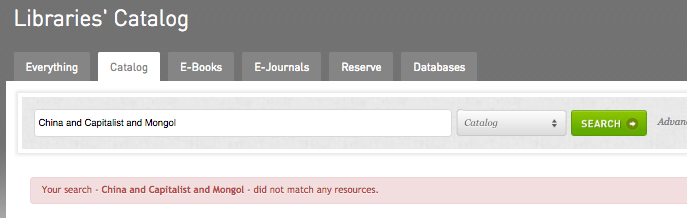 This search brings up nothing. Maybe instead of “Capitalist” it should be “Capitalism?” Maybe it should be “mongols” instead of “mongol invasion.” The key is to try different combinations of possible keywords.
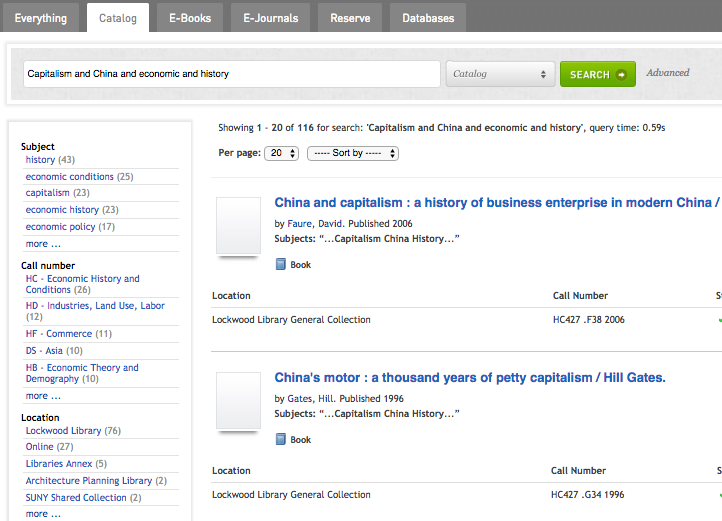 Instead of trying every variation or combination of terms, try a few search tricks: Asterisks, Word Substitution, Quotation Marks, and Broadening/Narrowing the Search.
This search brings up nothing. Maybe instead of “Capitalist” it should be “Capitalism?” Maybe it should be “mongols” instead of “mongol invasion.” The key is to try different combinations of possible keywords.
Instead of trying every variation or combination of terms, try a few search tricks: Asterisks, Word Substitution, Quotation Marks, and Broadening/Narrowing the Search.
The Asterisk
Use an asterisk to cover variants of a word. Capital* will cover: Capitalism, Capitalist, Capitalists, Capital. Similarly, Mongol* will cover: Mongol, Mongols, Mongol Invasion, Mongolia, etc. Using this trick, try a keyword search for: China and Mongol* and Capital*
Why did The origins of capitalism and the "rise of the West" (Mielants, 2007) come up? Click on the record and see the Table of Contents: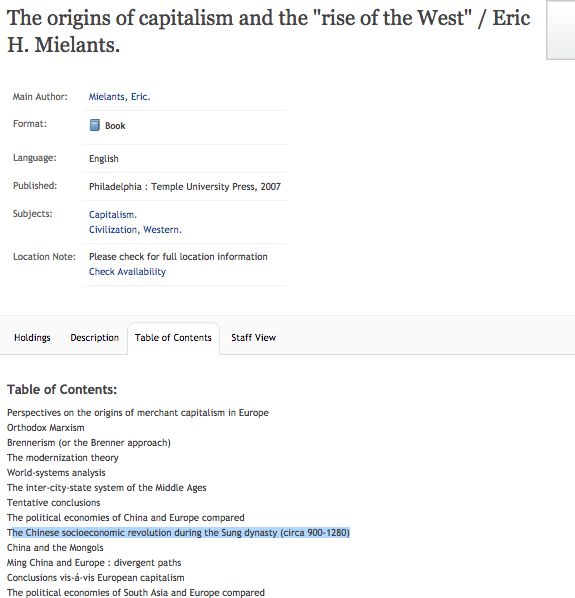 The words “China,” “Mongols,” and “Capitalism” are in the record, including the chapter “The Chinese socioeconomic revolution during the Sung dynasty (circa 900-1280).”
Why did The origins of capitalism and the "rise of the West" (Mielants, 2007) come up? Click on the record and see the Table of Contents:
The words “China,” “Mongols,” and “Capitalism” are in the record, including the chapter “The Chinese socioeconomic revolution during the Sung dynasty (circa 900-1280).”
Substituting Words
Try substituting words with synonyms. “Economics” or “Economy” in place of “Capitalism,” for example. Using the Asterisk trick again, try: China and Mongol* and Econom*
This gives us 61 books to consider.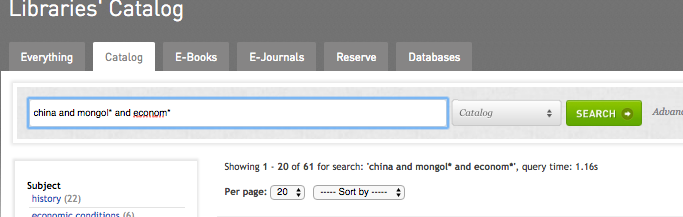
This gives us 61 books to consider.
Narrow and/or Broaden your search
Given the number of results an “Econom*” search yielded, perhaps “Capitalism in Pre-Mongol China” may be too narrow a search. The broader topic of “Economy in Pre-Mongol China” seems more fruitful.
Try a more focused search for specific dynasties. Instead of “China”, try “Song Dynasty” and Economy. Be sure to use quotation marks, so the catalog knows to search for the words together (otherwise, “Song” and “Dynasty” may appear paragraphs apart). This yields a number of books to consider: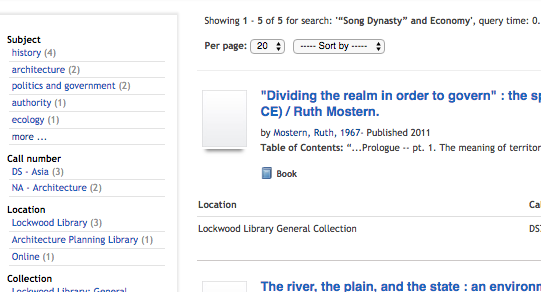 Finally, try a broader search. A history of a dynasty, such as the Song Dynasty, will discuss social, cultural, and economic fractures. Try a search for: “Song Dynasty” and History
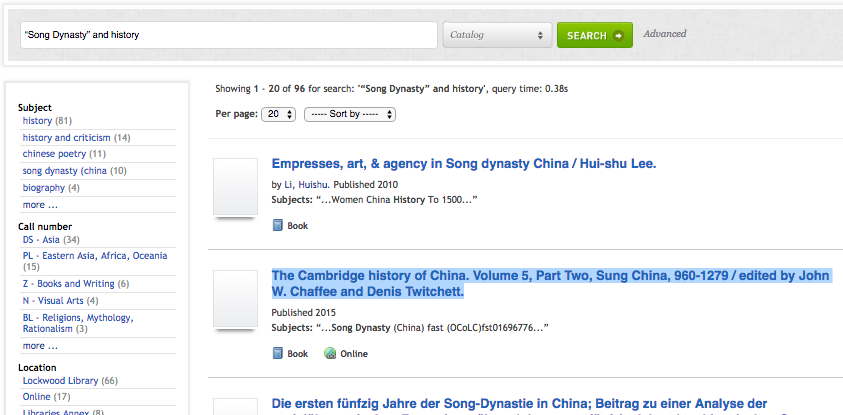 The Cambridge history of China (series Online), for example, is a good place to look.
Try a more focused search for specific dynasties. Instead of “China”, try “Song Dynasty” and Economy. Be sure to use quotation marks, so the catalog knows to search for the words together (otherwise, “Song” and “Dynasty” may appear paragraphs apart). This yields a number of books to consider:
Finally, try a broader search. A history of a dynasty, such as the Song Dynasty, will discuss social, cultural, and economic fractures. Try a search for: “Song Dynasty” and History
The Cambridge history of China (series Online), for example, is a good place to look.
Subject Terms
In addition to keywords, search with Subject Terms. These are specific tags used by librarians to identify the primary subject of a work, and they are consistent across all libraries in the United States. They are, however, hard to guess; unless you know the official subject Term, begin with keyword searching, then move on to subject searches.
When conducting keyword searches, notice “subjects” along the left side of the screen: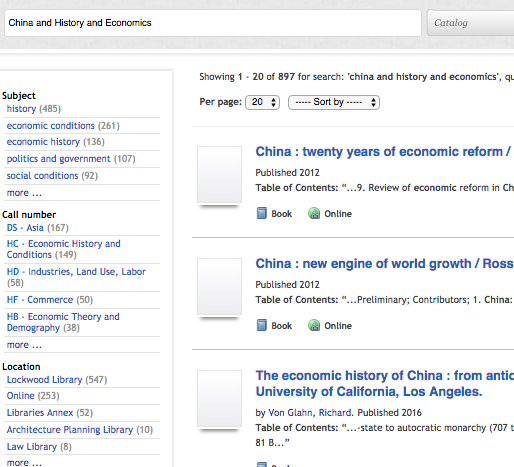 The terms “History,” “Economic conditions,” and others are official Subjects. Look at one of the records:
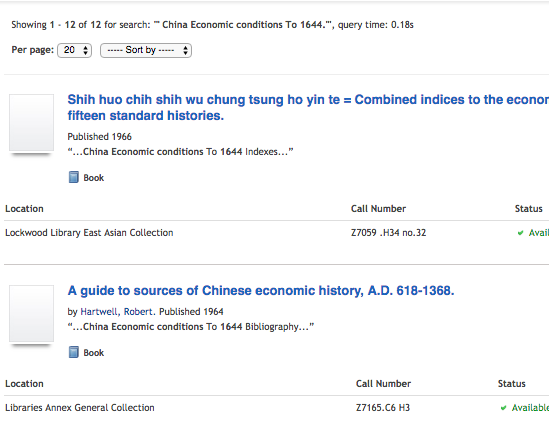
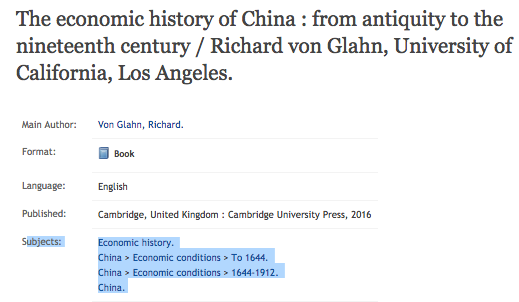 “China” and “Economic conditions” are subjects too. Click on these subject headings to find every book UB owns on the topic. If you click China > Economic Conditions > To 1644 you will find 12 similar works:
 Knowing that China, History, and Economic are official subjects, try a subject search for all three:
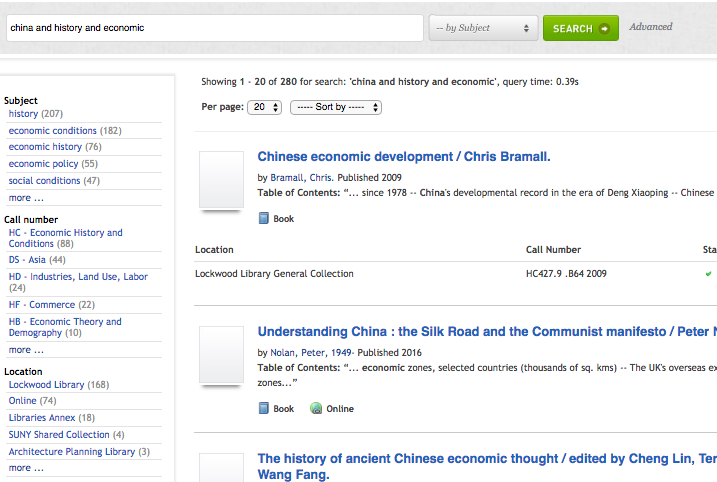 Not all of these books will cover your time period, but it is a good start. When finding books, pay attention to subject headings that may be useful.
When conducting keyword searches, notice “subjects” along the left side of the screen:
The terms “History,” “Economic conditions,” and others are official Subjects. Look at one of the records:
“China” and “Economic conditions” are subjects too. Click on these subject headings to find every book UB owns on the topic. If you click China > Economic Conditions > To 1644 you will find 12 similar works:
Knowing that China, History, and Economic are official subjects, try a subject search for all three:
Not all of these books will cover your time period, but it is a good start. When finding books, pay attention to subject headings that may be useful.
Useful Subject Terms
Subject terms will also work in our journal article databases. Use these Subject terms in combination to narrow your search results. Be aware: if you use too many at once, you may end up with zero results. Spend time trying several different combinations, and use other subject terms you find.
Useful Subject terms include:
China
History
Capitalism
“Economic conditions” [Note: the asterisk works here too; you can subject search for Econom* to cover multiple variants of the term]
“Social conditions”
“Song dynasty”
“to 1644”
“Yuan dynasty”
“Politics and Government”
Note: Each dynasty will have its own subject terms. Keyword search the dynasty, then look at the records of the books you find: the official subject will be listed there.
Useful Subject terms include:
China
History
Capitalism
“Economic conditions” [Note: the asterisk works here too; you can subject search for Econom* to cover multiple variants of the term]
“Social conditions”
“Song dynasty”
“to 1644”
“Yuan dynasty”
“Politics and Government”
Note: Each dynasty will have its own subject terms. Keyword search the dynasty, then look at the records of the books you find: the official subject will be listed there.
Additional Help
Still unable to find what you’re looking for? Feel free to contact me at []@buffalo.edu